
Neither Appeasement Nor War Will Free Iran
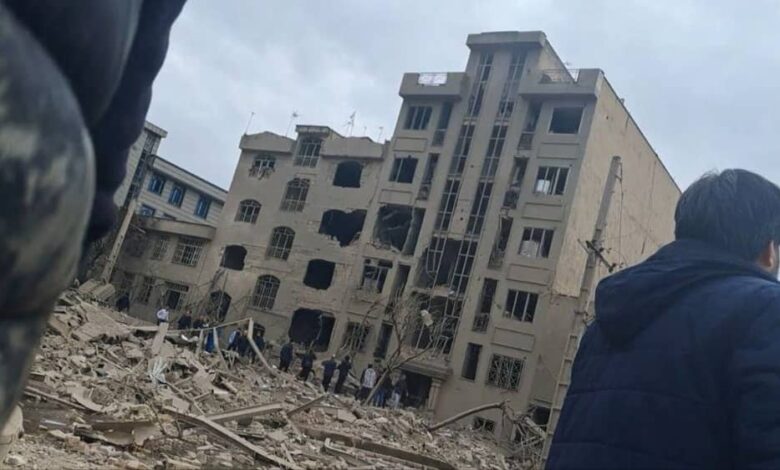
Destroyed buildings and damaged vehicles in Tehran at Bagheri Highway and Tahamtan Street after a midday bombing on March 16, 2026
Written by
Dr. Masumeh Bolurchi
For too long, the world treated the clerical regime in Tehran as a problem to be managed rather than a dictatorship to be confronted. The policy of appeasement was stretched to the breaking point. Every concession was justified in the name of stability. Every warning was dismissed as alarmism. Every delay was defended as diplomacy. But the result of this strategy is now impossible to deny: appeasement did not moderate the regime, restrain its ambitions, or make the region safer. It gave the mullahs time, money, legitimacy, and room to expand their machinery of repression at home and terrorism abroad.
The Iranian regime used that breathing space exactly as its critics said it would. It did not become more pragmatic. It became more aggressive. It tightened its grip on Iranian society while deepening its investment in proxy warfare, ideological radicalization, and regional destabilization. This was never merely a foreign-policy posture. It was a doctrine of survival. The regime has always understood that when its internal crisis sharpens, it must redirect attention outward. When the ground trembles under its feet in Iran, it tries to set the region on fire.
That is the proper context in which October 7, 2023, must be understood. The attacks were not simply another eruption in a long regional conflict. They also served the strategic interests of a regime facing the ever-present danger of nationwide uprising. Tehran has long relied on the export of crisis as a method of self-preservation. In effect, it sought to push its own survival crisis beyond its borders. Instead of confronting the growing rage of the Iranian people, it bet on regional war, mass trauma, and strategic confusion.
EU leaders’ policy of appeasement has emboldened #Iran’s regime to carry out acts of terror on European soil. The explosives that Javad Zarif’s ‘diplomat’ tried to use at the #FreeIran2018 Paris event was same type that ISIS used in France & Belgium. #ExpelIranDiplomatTerrorists pic.twitter.com/dkZ5tDxv51
— Mohammad Mohaddessin (@Mohaddessin) October 4, 2018
Khamenei, the principal architect of this doctrine, likely believed he knew how the script would unfold. He seems to have calculated that the Israeli backlash would resemble previous limited wars: catastrophic for Palestinians, destabilizing for the region, emotionally useful for Tehran’s propaganda, and yet still safely contained at a distance from the regime’s core. In that scenario, the mullahs would once again hide behind proxies, harvest political chaos, and buy themselves time at home.
But this time the calculation began to turn against its author. The regime that had so often operated through intermediaries found itself under more direct scrutiny. The head of the snake, long shielded by layers of deniability, became harder to ignore. This was not the outcome Tehran expected. It had planned for controlled escalation, not for the possibility that its own central role would become the focus.
Yet the failure of appeasement has produced a second illusion, one that is no less dangerous: the belief that war can solve what appeasement could not. This is where many governments, pundits, and strategists are still getting Iran wrong. Airstrikes, military escalation, and external pressure may weaken elements of the regime, but they do not automatically produce democratic change. In fact, war often gives dictatorships exactly what they need: a siege atmosphere, an excuse for greater repression, a pretext for nationalist blackmail, and an opportunity to close internal fractures.
NCRI Editorial: Appeasement with #Iranian Regime Cannot Change its Fate, Only Extend the Sufferinghttps://t.co/LkEJxCXVBN
— NCRI-FAC (@iran_policy) October 1, 2025
A dictatorship under bombardment does not necessarily collapse. It often hardens. It tells a frightened population that dissent is treason and that survival requires obedience. It uses the language of national defense to prolong domestic tyranny. That is why the notion that Iran can simply be bombed into freedom is as flawed as the earlier fantasy that it could be negotiated into decency.
Both schools of thought fail for the same reason: they misread the nature of the regime. Appeasement assumed the mullahs could be persuaded to behave like a normal state. War assumes they can be removed as though they were merely a military target. But the clerical dictatorship is not just a government with bad policies. It is an ideological system rooted in repression, religious absolutism, and organized violence. Its core problem is political, not merely diplomatic or military. And political systems of this kind are not ended by wishful diplomacy or by external force alone.
They are ended when the people they oppress reject them decisively, and when that rejection is organized into a real alternative.
#FreeIran2024 World Summit – Day 2
Appeasement of the Mullahs Betrays Freedom, Peace, Justice, and #HumanRights pic.twitter.com/eQCjlvsciR— Maryam Rajavi (@Maryam_Rajavi) July 1, 2024
That is the missing element in so much of the world’s debate on Iran. The decisive factor is neither another round of accommodation nor another round of war. It is regime change by the people of Iran and their organized resistance. Not chaos. Not foreign occupation. Not another recycled dictatorship in a different costume. A democratic transition led by Iranian people and their organized resistance.
This is the lesson the world is learning the hard way. Appeasement has already had its full historical trial, and it failed. Now some seem determined to give war the same exhaustive chance, as though missiles can accomplish what concessions could not. That too will fail if it is not anchored in the agency of the Iranian people. The road out of this crisis does not run through the survival calculations of the mullahs, nor through the destructive illusions of yet another regional war. It runs through the overthrow of a regime that has made terrorism, fundamentalism, and repression the pillars of its existence.
Neither appeasement nor war will free Iran. Only the Iranian people can do that, and only an organized democratic resistance can turn that possibility into reality.