
Ingrid Betancourt: The NCRI’s Provisional Government is the Only Responsible Pathway to a Democratic Iran
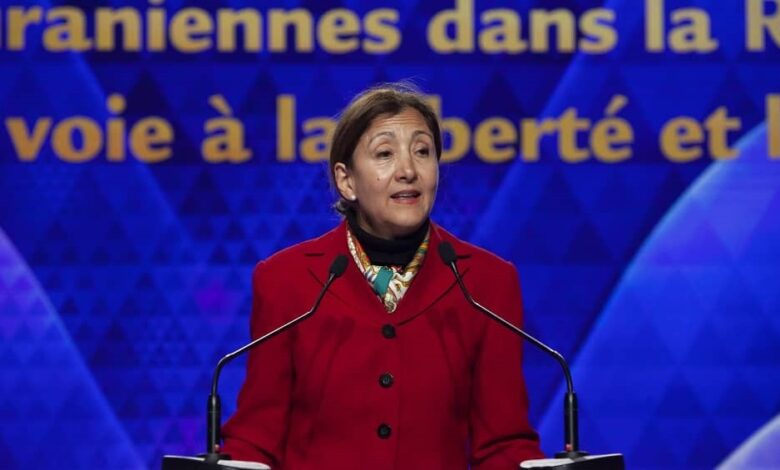
Ingrid-Betancourt
Written by
Shamsi Saadati
In a stirring address to an online conference held by the National Council of Resistance of Iran (NCRI) on March 5, 2026, former Colombian Senator and presidential candidate Ingrid Betancourt declared that Iran has reached a “historic turning point.” Citing the profound political vacuum created by recent geopolitical shifts and the death of Ali Khamenei, Betancourt argued that the Iranian regime is facing an unprecedented crisis of legitimacy. She emphasized that the only viable path forward is through the organized leadership of the NCRI and the implementation of Maryam Rajavi’s Ten-Point Plan.
Betancourt lauded the NCRI’s proposal for a provisional government as a structured, democratic alternative to the current theocracy, designed to prevent chaos during a regime collapse. She specifically highlighted the role of women within the movement and the courage of Resistance Units on the ground, asserting that the demand for a democratic republic is a “structural and operational” reality within Iran.
Furthermore, she delivered a firm rejection of both the current clerical rule and a return to the monarchy, stating that the Iranian people are looking toward a future defined by popular sovereignty rather than a “past of shame.” Betancourt concluded with a call for the international community to recognize the NCRI’s transitional government as the legitimate representative of the Iranian people’s aspirations.
The full text of Ingrid Betancourt’s speech follows:
Tune in to watch: #Women’s leadership, an imperative for a free Iran, a democratic republic. #IWD2026
Starting February 21, 2026, at 5:00 PM CEThttps://t.co/jixYCeuYux
— NCRI-FAC (@iran_policy) February 21, 2026
Thank you so much.
My dear Maryam Rajavi, dear resistance leaders and Resistance Units heroes and heroines, distinguished friends. This is the moment we have been longing for so so so long. We meet today at a moment of extraordinary consequence for the future of Iran. The recent strike by the United States ordered by President Trump combined with the death of Ali Khamenei has created a profound political vacuum at the heart of the Iranian system.
What we are witnessing is not simply instability but a historic turning point that may determine whether Iran descends into chaos or moves towards democracy. At such a critical juncture, it is essential to support a responsible and structured pathway for political transition. And in this context, the initiative of the National Council of Resistance of Iran, the NCRI, to establish a provisional government deserves serious international consideration.
Moments of regime collapse can easily produce disorder if not guided by an organized alternative and the NCRI proposal offers precisely that, a transitional authority capable of managing this decisive period while ensuring that sovereignty is transferred peacefully to the Iranian people. According to its program, after the fall of the regime, free and fair elections would be held within six months, and power would be transferred to the legitimate representatives chosen by the people.
At the heart of this democratic alternative stands the Ten-Point Plan presented by Maryam Rajavi, our dearest president-elect of the resistance. This plan outlines a clear vision for a democratic republic in Iran based on universal suffrage, free elections, and the separation of religion and state. It is a revolution. It guarantees freedom of expression, political pluralism, the abolition of the death penalty. It commits to gender equality, protection of minority rights, and the creation of an independent judiciary grounded in the rule of law.
This woman leads Iran’s resistance. She calls for ending tyranny and for unity with Iranians suffering. The regime threatens the world, but first its own people. The January 2026 bloodshed marked a point of no return. Iran must move toward democracy; Rajavi’s call is a first step…
— Ingrid Betancourt Pulecio (@IBetancourtCol) March 1, 2026
The plan also envisions a non-nuclear Iran that lives in peace with its neighbors and engages constructively with the international community. It supports a market economy, environmental protection and equal opportunities for all citizens regardless of ethnicity, religion, gender. It proposes decentralization that respects the culture and administrative rights of Iran’s very, very diverse communities.
Taken all together, these principles provide a coherent blueprint for rebuilding Iran as a modern democratic state. Now the leadership of Maryam Rajavi has been essential in sustaining and uniting the Iranian Resistance during decades of repression. Her leadership combines strategic clarity with resilience and a steadfast commitment to democratic values. She has consistently advocated for a secular and pluralistic Iran while mobilizing international awareness and support for the Iranian people’s struggle.
That’s why we’re here all of us. One particularly powerful dimension of her leadership I believe is the role she has championed for women within the resistance movement and knowing that she’s confronting a very misogynistic regime. Under her guidance, women occupy key leadership positions throughout the movement, and this is not symbolic, this is structural.
It demonstrates in practice the commitment to gender equality envisioned in her political program and stands in sharp contrast to the misogynistic policies of the current regime and the last previous regime. At the same time, it must be clearly stated that the solution for Iran cannot come from foreign intervention, nor from attempts to reform a system whose foundations are authoritarian.
Apoyo la manifestación en Bruselas el 6 de septiembre por 🇮🇷 Irán Libre y la Tercera Opción de Maryam Rajavi: no a la guerra, no a la apaciguamiento, cambio de régimen por parte del pueblo y su resistencia organizada.
Je soutiens le rassemblement à Bruxelles du 6 septembre pour… pic.twitter.com/ko2isI3zVw
— Ingrid Betancourt Pulecio (@IBetancourtCol) September 1, 2025
Lasting change must come from the Iranian people themselves supported by their organized resistance. The courage shown by citizens during repeated nationwide uprisings by students, workers, and especially by women reveals a deep and enduring demand for freedom and dignity.
For more than four decades the National Council of Resistance of Iran has prepared for this moment. It has developed political programs, cultivated diplomatic relationships all over the world and maintained organizational structures aimed at establishing democracy in Iran. This continuity and preparation make it uniquely positioned to help guide a complex transitional period. Within this coalition, the MEK, the People’s Mojahedin Organization of Iran, serves as the principal member and the backbone of the organized resistance.
Despite relentless repression over more than four decades, the movement has maintained networks and support structures that allow it to remain active inside Iran, mobilizing supporters and documenting the regime’s abuses. The existence of organized Resistance Units on the ground is of particular significance in the current moment of uncertainty. Even under extremely difficult conditions activists affiliate or affiliated with the movement, with the MEK, continue to organize and challenge the regime structures of control.
Their activities demonstrate that opposition to the regime is not merely ideological but structural, operational, providing an important foundation for a people-led transition. Now recent confrontations attributed to Resistance Units including actions targeting highly secure locations linked to the leadership compounds of Ali Khamenei have illustrated the growing vulnerability of the regime’s power centers. And while the objective remains a peaceful democratic transition, these actions and developments reveal the depth of internal tensions within an increasingly fragile system.
Former Colombian Senator @IBetancourtCol: “The @Mojahedineng is not just an option. It is the only option. It is the foundation of change and the face of hope for #Iran. The free world must embrace this mission now.” pic.twitter.com/v63p23X5Ob
— NCRI-FAC (@iran_policy) August 6, 2025
At the same time, the Iranian people have made something else unmistakably clear. They reject dictatorships in all its forms. During recent uprising and student protests, this has been mentioned before, one of the most widely heard slogans has been “Death to the oppressor, whether Shah or the Supreme Leader”. And another very powerful chant across universities has been “Neither Shah nor mullahs, long live freedom and democracy”.
And these voices reflect a broad societal consensus because after decades of repression under both monarchical and theocratic rule, Iranians are not seeking to return to the past, they are demanding a democratic republic based on popular sovereignty, freedom, and equality. And in this context, attempts to promote the restoration of monarchy by Reza Pahlavi have proven divisive and disconnected from realities inside Iran.
While he presents himself internationally as a unifying figure, we know and we note that he lacks an organized political structure and a credible grassroots network within the country. His influence remains largely confined to segments of the diaspora and amplified through media narratives rather than rooted in sustained organization on the ground and such efforts risk fragmenting the opposition and distracting from the central objective shared by many Iranians, the establishment of a democratic republic through the struggle of the Iranian people and their organized resistance.
Dear friends, history occasionally offers rare moments when the future of a nation can be reshaped. Iran may now be approaching such a moment. The international community cannot determine the destiny of the Iranian people, but it can recognize and support their legitimate aspirations. Supporting a democratic transition led by the Iranian people themselves, guided by an organized resistance and grounded in clear democratic principles offers the most credible path forward.
Watch the 10-min recap of #FreeIran2025 Summit’s 3rd session in Rome (July 31), featuring @Maryam_Rajavi, @GiulioTerzi, @LucioMalan, @RudyGiuliani, @CharlesMichel, @matteorenzi, @JamesCleverly, @CarlaHSands, @IBetancourtCol, @naike_gruppioni, @MarcoScurria, @chavezlinda,… pic.twitter.com/jyl1VIHmNQ
— NCRI-FAC (@iran_policy) August 4, 2025
Maryam Rajavi represents the bright future of Iran. She has devoted her life to the struggle for freedom and democracy. Reza Pahlavi represents the dark past, a past marked by cruelty, corruption, and widespread violation of human rights, not fundamentally different from the regime of Khamenei. While Maryam Rajavi was sacrificing her life to lead her people towards democracy, Reza Pahlavi was enjoying the privileged life of a wealthy jet setter.
We must make it absolutely clear: we stand with the future, not with the past of shame. All democracies must recognize the transitional government of the NCRI immediately. The Iranian people have paid with their lives during decades for freedom. With courage, unity, and international understanding that future is finally within reach. We will not leave Iranians alone. We will not let you down.
And let me end by this promise: our next meeting, dear Maryam, will be in Tehran, not in exile, not in hope alone, but in freedom, in a free Iran where this nightmarish regime will be gone forever. And on that day, we will be dancing in the streets of Tehran with the heroes and heroines of the Resistance because the time of the Iranian people has finally come.