
Regime Media Humiliated in Live Broadcast as Resistance Expands Activities Across Iran
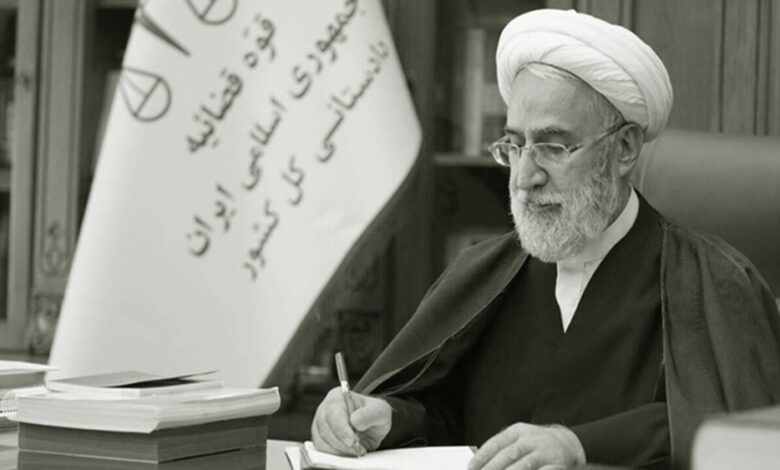
Iranian regime Prosecutor General, Mohammad Movahedi
Written by
Mansoureh Galestan
As the Iranian regime attempted to orchestrate its annual show of force to mark the anniversary of the 1979 revolution, the veneer of control shattered on live state television. Against the backdrop of a volatile society and a nationwide uprising that began in late 2025, the clerical dictatorship is facing a deepening crisis of legitimacy, highlighted by a humiliating broadcast blunder in Zahedan and a subsequent surge in organized resistance operations across the country.
The “Death to Khamenei” Scandal on State TV
During the state-organized parade on February 11, 2026 (22 Bahman), in Zahedan, the capital of the restive Sistan and Baluchestan province, the regime’s propaganda machine suffered a catastrophic failure. A reporter for the state broadcasting network, intending to narrate a script of loyalty to the system, inadvertently broadcast the reality of the streets.
While live on air, the flustered reporter announced that the crowds were chanting, “Death to Khamenei.” The statement, which slipped out instead of the usual state-sanctioned slogans, sent shockwaves through the local broadcasting center. The incident forced the reporter to release a frantic apology video, which only served to further highlight the regime’s insecurity.
In his video statement, intended to “correct” the narrative, the reporter defensively lashed out at the opposition, inadvertently acknowledging the widespread public disdain for the regime’s supporters. He complained that “counter-revolutionaries” accuse the regime of using “AI, archive footage,” or bribing attendees with free treats to fill the streets. “I wanted to report this passionate presence… unfortunately, a verbal slip came out,” he stammered, attempting to frame the chant of “Death to Khamenei” as a mere linguistic accident rather than a Freudian slip reflecting the dominant mood of the nation.
Judiciary Fears: Prosecutor General Threatens Detainees
Reacting to the continued unrest, the regime’s judiciary has doubled down on threats against protesters arrested during the recent uprising. On February 13, 2026, the regime’s Prosecutor General, Mohammad Movahedi, issued a stark warning, signaling that the state has no intention of showing mercy to those demanding change.
Mohammad Movahedi explicitly stated that there would be “no leniency” for detainees and demanded that their judicial processing be expedited to finalize their sentences quickly. In a move designed to financially cripple dissidents and their families, he also insisted that “rioters” must pay for “damages” to public property. This rhetoric reflects the regime’s fear of the lingering potential for renewed mass protests and its reliance on execution and financial ruin as primary tools of suppression.
Volatile Security Situation: Senior Police Commander Killed
The fragility of the regime’s grip on security was further exposed on February 13, 2026, with the death of a high-ranking police commander in Ferdows, South Khorasan province. According to the state-run Fars News Agency, Colonel Mohammad Sane’i-pour was killed during an armed clash.
The incident occurred when police attempted to inspect a vehicle on one of the city’s main axes. The driver opened fire with a handgun, wounding the colonel, who later died in the hospital. This clash is symptomatic of a broader breakdown in the regime’s authority, where security forces are increasingly vulnerable even during routine operations.
PMOI Resistance Units: The “Red Line” Against Dictatorship
Amidst this atmosphere of instability, the organized opposition has intensified its political campaign. On February 13, Resistance Units affiliated with the People’s Mojahedin Organization of Iran (PMOI/MEK) in Zahedan carried out activities emphasizing a clear political demarcation: the rejection of both the current theocracy and the past monarchy.
February 13—Zahedan, southeast Iran
PMOI Resistance Units resume weekly anti-regime activities, reiterating their commitment to the overthrow of the mullahs' rule, the establishment of a democratic republic, and rejection the return to the shah dictatorship.#No2ShahNo2Mullahs pic.twitter.com/EghzB88C2m— People's Mojahedin Organization of Iran (PMOI/MEK) (@Mojahedineng) February 14, 2026
Placards displayed in public spaces bore slogans such as “We want neither Shah nor Mullahs” and “A dictator is a dictator, whether with a turban or a crown.” These activities aim to clarify the direction of the uprising that began on December 28, 2025, initially sparked by a bazaar merchants’ strike in Tehran over the collapsing rial. The Resistance Units warn that the democratic revolution must not be hijacked by remnants of the Pahlavi dictatorship, asserting that the Iranian people’s struggle is for a future defined by freedom, not a return to the past.
Rebellious Youth: 50 Operations Avenging Martyrs
At the same time, Iran’s rebellious youth have launched a campaign to avenge the thousands of protesters killed during the bloody crackdown of January 2026. In a coordinated wave of defiance, these youth groups executed 50 operations targeting the regime’s apparatus of suppression.
NCRI Statement: Names of 156 More Proud Martyrs of #Iran's Nationwide Uprising, Including 14 Women and 22 Children and Teenagershttps://t.co/fvIlS8bnN2
— NCRI-FAC (@iran_policy) February 9, 2026
In Tehran, Shahriar, Varamin, and Kerman, Rebellious Youth set fire to IRGC Basij bases responsible for enforcing repressive codes against women and students. In Shahriar, the command headquarters of the State Security Force was targeted. Furthermore, the regime’s surveillance network was challenged as intelligence directorate signs were torched in Rasht, Qazvin, and Kermanshah.
The operations also targeted the symbols of the regime’s ideology. Banners and billboards featuring Supreme Leader Ali Khamenei, the eliminated terror master Qassem Soleimani, and Ebrahim Raisi were set ablaze in cities including Mashhad, Ahvaz, Zahedan, and Sabzevar. These actions send a definitive message: the wall of fear has collapsed, and the regime’s brutality has fueled, rather than extinguished, the determination of the Iranian people to overthrow the dictatorship.