
Iran Uprising: Students Defy Crackdown as Regime Targets Doctors and Hospitals
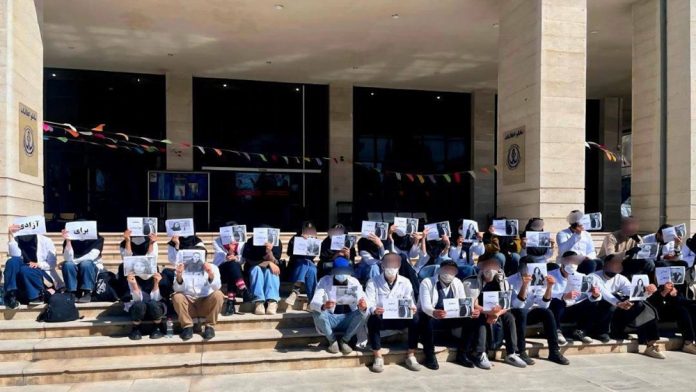
Protest by medical students in Shiraz on February 5, 2026
Written by
Mansoureh Galestan
As the nationwide uprising in Iran extends into February, the clerical regime has intensified its crackdown, resorting to military-grade violence against unarmed protesters and launching a vindictive campaign against medical professionals treating the wounded. Despite the internet blackouts and the severe repression ordered by Supreme Leader Ali Khamenei, rebellious youth and student bodies across the country continue to organize, signaling that the unrest sparked in January has evolved into a sustained movement for regime change.
University Campuses as Bastions of Defiance
On Tuesday, February 3, 2026, university campuses became the epicenter of the latest wave of dissent. Students at the Universities of Medical Sciences in Mashhad and Shiraz, as well as the Faculty of Dentistry in Tabriz, staged sit-ins and rallies. These demonstrations were not merely academic; they were direct responses to the killing of fellow students during the January protests.
In moving scenes captured by citizen journalists, students in Mashhad chanted, “The student dies but accepts no humiliation,” and “This withered flower is a sacrifice for the homeland.” The protests highlight a significant breach in the regime’s control, as universities—traditionally heavily monitored by the Basij paramilitary—openly defy the security apparatus.
Armed Resistance in Gachsaran
While students protested peacefully, the confrontation took a kinetic turn in Gachsaran. In the early hours of Wednesday, February 4, there was an armed attack on a law enforcement station. According to state-run media, the clash resulted in the death of an officer with the repressive forces. The state-affiliated news agencies confirmed that the attackers successfully retreated from the scene following the operation.
Healers: Regime Targets Medical Staff
In a desperate bid to identify injured protesters who avoid government hospitals for fear of arrest, intelligence services have turned their sights on the medical community. A report published by Le Monde on February 3 reveals a harrowing campaign of intimidation against doctors.
The report details the case of “Sanam” (a pseudonym), a young physician in Tehran. After refusing a demand by hospital security intelligence to hand over the names and ID numbers of injured protesters, security forces raided her home. Officers threatened her with death if she did not cooperate within days, forcing her into hiding. Le Monde notes that at least 25 doctors and nurses have been arrested recently.
Brutality on the Streets: “Dishonorable!”
New footage emerging from the internet blackout sheds light on the sheer brutality deployed during the January peaks of the uprising. Videos from Ardabil, dated January 8 and 9, show special police units deliberately driving armored vehicles into crowds of protesters at high speed.
Further footage from Mashhad and Urmia confirms the use of live ammunition against unarmed crowds. In one clip from Urmia, as security forces fire directly at youth attempting to evacuate the bodies of martyrs, the crowd does not disperse but stands its ground, chanting “Disgraceful!” (Bi-sharaf) at the shooters.
Voices from Behind Bars
The crackdown has filled the prisons, but it has not silenced the political prisoners. From Ghezel Hesar Prison, political prisoner Akbar Bagheri released a message this week honoring the martyrs of the uprising. He specifically eulogized Dr. Naeem Abdollahi, a 34-year-old assistant professor at the University of Tehran, who was killed by security forces on January 8 in the Nazi Abad district of Tehran.
“Amidst the rattle of the regime’s machine guns, there are youth who pledge their lives,” Bagheri wrote, vowing to stand with the people until the regime’s overthrow.
International Condemnation Mounts
The international community is increasingly isolating Tehran as evidence of these atrocities mounts. On February 5, 2026, German Foreign Minister Johann Wadephul and Australian Foreign Minister Penny Wong issued a joint statement from Canberra. They condemned the “brutal action of the Iranian regime against its own population” and expressed “great concern” over the number of victims and arbitrary detentions.
Concurrently, the Australian Senate passed a motion condemning the repression, with Senator Raff Ciccone highlighting that the Albanese government has now sanctioned over 200 Iranian individuals and 100 IRGC-linked entities. In Europe, the City Council of Rome’s 7th District unanimously passed a motion supporting the Iranian people’s fight for democracy, recognizing the global nature of the struggle for freedom.
https://www.ncr-iran.org/en/news/iran-protests/iran-uprising-students-defy-crackdown-as-regime-targets-doctors-and-hospitals/