
Protests and Torture Reports Continue in Iran as Khamenei Warns of ‘Regional War’
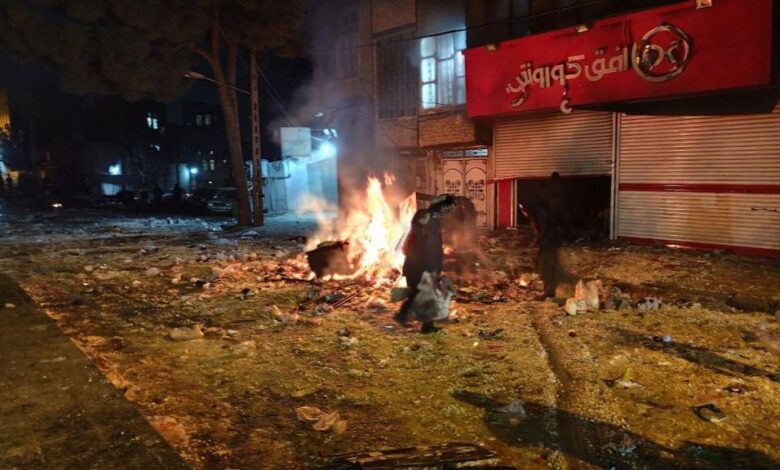
Iran Protests – January 2026
Written by
Mansoureh Galestan
On February 1, 2026, the Iranian regime’s Supreme Leader Ali Khamenei delivered a speech that betrayed a deepening sense of crisis within the ruling theocracy. Speaking on the anniversary of the 1979 revolution, Khamenei attempted to downplay the looming threat of conflict while simultaneously issuing dire warnings. His remarks come at a moment of unprecedented vulnerability for the regime: a nationwide uprising has persisted since late December, and on January 29, the European Union officially designated the Islamic Revolutionary Guard Corps (IRGC) as a terrorist organization.
In his address, Khamenei referenced US military threats, claiming that “all options on the table” is a tired slogan intended to frighten the Iranian people. However, he immediately pivoted to a defensive posture, warning that if a conflict were to erupt, it would not be contained. “If the Americans start a war this time, it will be a regional war,” Khamenei threatened. This rhetoric aims less at deterring foreign powers and more at bolstering the collapsing morale of his Basij forces, who are currently overwhelmed by the popular uprising.
Hollow Threats and Admissions of Weakness
The regime’s reaction to the European Union’s decision to blacklist the IRGC has been characterized by angry outbursts and finger-pointing. The designation, finalized on January 29, 2026, cites the IRGC’s role in brutal domestic suppression and regional instability.
Inside the regime, officials are scrambling to assign blame. Sadeq Larijani, the head of the Expediency Discernment Council, explicitly pointed to the Iranian Resistance as the driving force behind the EU’s decision. In a statement, he admitted that European politicians had acted “in harmony with the Mojahedin [PMOI/MEK]” to designate the IRGC.
Meanwhile, Parliament Speaker Mohammad Bagher Ghalibaf resorted to theatrical threats. During a parliamentary session where lawmakers donned IRGC uniforms, Ghalibaf threatened that the regime would label European armies as terrorist groups in retaliation. The government of Masoud Pezeshkian also issued a statement condemning the move, claiming the EU had set foot on a “wrong path.” These reactions highlight the regime’s fear of losing its remaining international legitimacy and economic lifelines.
Resistance Units commander Naeem Abdollahi and 18-year-old Mohammad Bahrami killed by regime forces during Iran protests https://t.co/NEiB7y0LHh
— People's Mojahedin Organization of Iran (PMOI/MEK) (@Mojahedineng) January 30, 2026
The Human Cost: Torture and Suspicious Deaths
While the regime postures on the international stage, it continues a savage war against its own population. Despite severe internet blackouts intended to hide crimes against humanity, harrowing reports are emerging from Iranian cities.
On January 29, the body of 19-year-old Taha Soleimani was returned to his family, 20 days after he disappeared during protests on January 9. Reports indicate his body bore severe signs of torture inflicted at the notorious Kahrizak detention center. In a display of defiance, his family and mourners turned his funeral at Behesht-e Zahra cemetery into a protest. His uncle, addressing the crowd, declared, “Clap for my nephew, for this lionhearted boy,” refusing to mourn in silence.
Similarly, in Khorramabad, mourners gathered to bury Mohammad Hossein Parnoun, a 16-year-old national kickboxing champion. He was shot and killed by security forces on January 9.
The crackdown has also intensified within universities. Reports confirm the “suspicious and simultaneous” deaths of two medical students, Farhad Salari and Erfan Taherkhani, in a dormitory in Tehran. Student activists believe these deaths are linked to the intensified suppression following protests over the death of another student, Aida Heidari.
January 31—Mashhad, northeast Iran
A group of students at Ferdowsi University held protest rally after the suspicious death of students and refused to attend exams.#IranProtests pic.twitter.com/TXXT7pExlU— People's Mojahedin Organization of Iran (PMOI/MEK) (@Mojahedineng) February 1, 2026
Global Condemnation: “Days Are Numbered”
The international community is no longer turning a blind eye to these atrocities. In a sharp departure from past diplomatic caution, German Chancellor Friedrich Merz issued a stark warning to Tehran on January 30.
“A regime that can only keep itself in power with brute force and terror against its own population—its days are counted,” Chancellor Merz stated during a press conference. He affirmed that Germany stands with the Iranian people and confirmed that Berlin had actively pushed for the EU’s terrorist designation of the IRGC. Foreign Minister Wadephul added that the IRGC is responsible for “executing their own people because they dared to raise their voices.”
Simultaneously, Amnesty International issued an urgent alert on January 30, warning that thousands of detainees from the recent uprising are at risk of torture, sexual violence, and the death penalty. The human rights organization noted that the Head of the Judiciary has ordered prosecutors to “act without leniency,” a directive that has historically preceded mass executions.