
Why Iran Is Running Out of Water, Power — and Patience
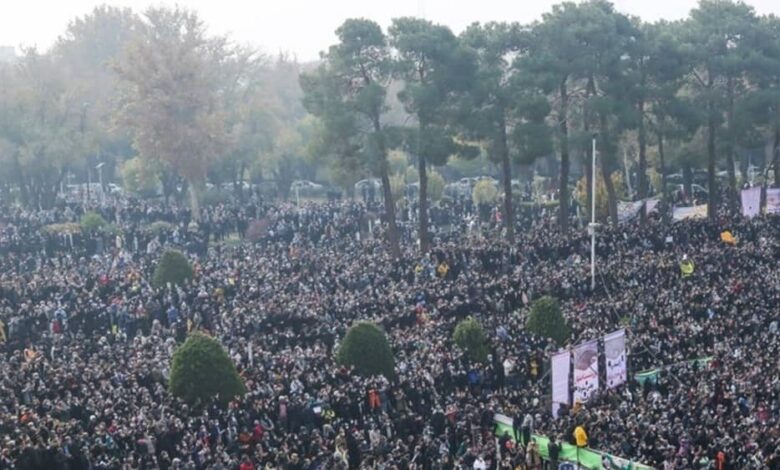
Outraged by the state-sanctioned drying of the Zayandeh Rud River, tens of thousands of Isfahan residents gathered on its parched bed to protest on November 19, 2021
Written by
Shahriar Kia
Introduction
Iran is facing an escalating water and electricity crisis decades in the making. Despite having vast oil, gas, and water resources in certain regions, chronic mismanagement under the clerical regime has left rivers dry, aquifers depleted, power plants decaying, and blackouts routine. Today, over half of Iran’s dams hold less than 40% capacity, while rolling electricity outages disrupt daily life and industry.
This report examines how regime policies—from aggressive dam construction and overuse of groundwater to neglect of energy infrastructure—have compounded environmental pressures into today’s emergency. It analyzes the role of the IRGC “water mafia”, the prioritization of self-serving projects like cryptocurrency mining and water-hungry heavy industries, and the resulting socioeconomic fallout. It also explores environmental and geopolitical factors, the government’s inadequate responses, and how water and power shortages are driving unprecedented public dissent across Iran.
Origins of Water Mismanagement and Dam Overdevelopment
In the 1980s and 1990s, the clerical rulers pursued a massive program of dam building and agricultural expansion under the banner of self-sufficiency. After the Iran–Iraq War (1980–88) left the Islamic Revolutionary Guard Corps (IRGC) without a clear military purpose, President Akbar Hashemi Rafsanjani’s “reconstruction jihad” integrated the Guards into the national economy to preserve their influence and morale.
In 1992, the IRGC created its dam-construction arm, Sepasad, under the Khatam al-Anbiya Construction Headquarters. Over the next decades, Iran built hundreds of dams—ranking third globally—often without environmental assessments or long-term planning. Projects were driven more by political motives and profit than sustainable water management.
Why Is #Iran Regime Hiding Information on Dams? https://t.co/eM5JUrmytx pic.twitter.com/HcSIE8mqUG
— NCRI-FAC (@iran_policy) October 31, 2017
A notorious case is the Gotvand Dam on the Karun River, completed in 2011. Experts had warned of a massive salt formation at the site, but politically connected contractors pushed the construction through. Once filled, the reservoir leached salt into the river, drastically raising salinity downstream. Attempts to seal the salt layer failed within days, creating a saline lake that remains unresolved more than 10 years later. Costs doubled to $3.3 billion, illustrating how the IRGC-linked “water mafia” profited from inflated contracts while ignoring environmental damage.
Overzealous dam construction disrupted river flows and destroyed wetlands. Once-vital rivers like the Zayandeh Rud have been reduced to seasonal mudflats. Even state media now admit “unscientific projects, such as unregulated dam construction, are the main cause” of water shortages, not drought alone. Experts describe Iran as suffering “water bankruptcy”—demand far exceeding sustainable supply.
Groundwater Depletion and Irrigation Overuse
Less visible than dams but even more destructive, Iran’s groundwater reserves have been drained at alarming rates since 1979, with the steepest declines in the past two decades. The regime’s “food self-sufficiency” push encouraged expansion of irrigation and widespread drilling of wells across the plains. Today, over 75% of Iran’s land area is experiencing extreme groundwater overdraft—extraction far beyond natural recharge.
A 2018 study estimated 74 cubic kilometers of groundwater were depleted between 2002 and 2015 alone, driving land subsidence, soil salinization, and the collapse of aquifers. In Tehran’s metropolitan area, the ground is sinking by several millimeters per year, threatening buildings and infrastructure.
#Iran’s Water and Power Crisis: A Mirror of Administrative Collapse and the Regime’s Fear of Public Outragehttps://t.co/Jv8FtSbMPc
— NCRI-FAC (@iran_policy) July 30, 2025
Agriculture consumes about 90% of Iran’s water, often with inefficient methods. Traditional water-saving practices have been abandoned in favor of thirsty crops like wheat, rice, and sugar beet—sometimes in arid zones wholly unsuited to such cultivation. This shift was fueled not only by farmers’ choices but also by politically connected mega-projects.
One example is Supreme Leader Ali Khamenei’s 1996 “550,000-hectare project” in Khuzestan and Ilam, which seized vast tracts of land and diverted Karun River water to industrial-scale farms controlled by regime-linked institutions. While marketed as boosting agriculture, the project accelerated regional drought, displaced locals, and funneled profits to elite networks. By 2018, the second phase’s cost had ballooned to 20 trillion tomans, deepening its economic and environmental toll.
The number of registered wells nearly doubled from 460,000 in 2002 to 794,000 in 2015, with thousands more illegal wells operated by those with regime protection. By 2021, officials admitted that uncontrolled drilling had brought Iran “rapidly approaching water misery”—a point of no return.
In places like Isfahan, where the Zayandeh Rud has vanished, tensions have erupted into “water riots.” Farmers have accused the IRGC’s water mafia of diverting water to industry, at times damaging pipelines in protest. The crisis has pitted provinces against each other—Isfahan’s farmers demand water for crops, while Yazd’s residents rely on trucked water for drinking—turning a resource challenge into a social conflict.
#Iran's Water and Power Crisis Deepens Amid Government Mismanagement and Public Outragehttps://t.co/9EWSACsAbz
— NCRI-FAC (@iran_policy) July 21, 2025
Decay of Energy Infrastructure and Power Shortages
Alongside its water crisis, Iran’s electrical grid is collapsing after decades of underinvestment, sanctions, and regime mismanagement. For years after 1979, electricity expansion relied mainly on state-funded oil and gas plants (plus some hydro), but maintenance and upgrades lagged. By the 2010s, many plants were aging, inefficient, or operating below capacity, with about 13% of generated power lost to technical issues and theft.
With demand rising roughly 4% annually and reaching 292 terawatt-hours in 2022, supply fell short. By summer 2024, Iran faced a 14,000 MW shortfall—about 15% of peak demand—double the entire capacity of neighboring Azerbaijan. Winter 2024–25 was worse: a severe cold snap caused natural gas shortages for both heating and power generation, triggering rolling blackouts in up to 30 provinces. Even Tehran went dark for hours, and streetlights were turned off at night to save power.
Desperate measures included burning mazut (heavy fuel oil) in power stations, blanketing cities in toxic smog. One lawmaker called it “an order to kill people” due to the health risks.
Gas production remains high but cannot meet domestic demand and export commitments, partly due to sanctions blocking new development. Years of failing to add the required 5 GW of new capacity annually left plants underpowered. Privatization handed facilities like Abadan and Zagros plants to regime-linked entities (e.g., Setad, the Martyrs Foundation) who pocketed profits while letting them decay.
By late 2024, the government ordered schools, offices, and even banks closed on extreme weather days to reduce energy use. Officials warned Tehran could face four-day work weeks in summer if consumption wasn’t cut. Public outrage grew when it was revealed that, despite domestic shortages, electricity exports rose 92% in early 2023—seemingly for revenue or political leverage—while ordinary Iranians endured blackouts.
#Iran Faces Escalating Crisis Amid Power Outages and Economic Woeshttps://t.co/E1S7n7ZB9f
— NCRI-FAC (@iran_policy) August 25, 2024
The IRGC “Water Mafia” and Regime Entities’ Role
Iran’s water and power failures are rooted in the domination of state and parastatal giants—above all the IRGC. With its engineering arm, Khatam al-Anbiya, becoming the regime’s go-to contractor for dams, tunnels, and water-transfer schemes, the IRGC was warded no-bid contracts and shielded from oversight. This network of IRGC firms, bonyads, and bureaucrats—dubbed the “water mafia”—profits from megaprojects regardless of their environmental or social costs.
Under Supreme Leader Ali Khamenei’s patronage, regulators have been sidelined, whistleblowers silenced, and projects pushed through despite clear risks. The Corps and its partners have also drilled unauthorized deep wells and diverted rivers to feed IRGC-owned factories and heavy industries, leaving farmland in provinces like Khuzestan and Isfahan to wither. Water has been turned into a private commodity for elite profit, while ordinary farmers lose their rights and livelihoods.
The same model extends to energy. The IRGC and Basij militia have been accused of siphoning subsidized fuel, smuggling an estimated 1.5 billion liters a year, and taking over strategic assets like refineries and power plants only to run them into disrepair. Their dominance over parts of the power grid has prioritized political and financial gain over technical efficiency. Most strikingly, the regime’s endorsement of cryptocurrency mining—much of it run by IRGC-linked operators—has diverted huge amounts of electricity from the public, effectively trading citizens’ access to power for untraceable revenue.
As one Iranian outlet put it, Iran’s crisis is “a catastrophe brought upon the country through mismanagement and organized plunder.”
The recently revealed classified documents shed light on the IRGC's control over Iran's oil revenue, underscoring the regime's corruption and economic mismanagement.https://t.co/genvxrs91b
— NCRI-FAC (@iran_policy) May 24, 2023
State Priorities: Crypto Mining, Heavy Industry, and Proxy Funding
While Iranians endure water rationing and blackouts, the regime has channeled scarce resources into ventures that serve its political and financial interests. One of the most damaging is state-sanctioned cryptocurrency mining, legalized in 2019 and granted ultra-cheap electricity on condition the proceeds flow to the Central Bank. The sector is dominated by IRGC-linked operators and Chinese partners running massive farms—one site in Tehran alone reportedly consumed as much power as 11 provinces combined.
By 2021, Iran accounted for roughly 4.5% of global Bitcoin mining, diverting 600–2,000 MW from the grid—up to 20% of the national power deficit during peak demand. When authorities briefly shut down 900,000 illegal devices in 2023, national power use dropped 2,400 MW overnight, proving the scale of the drain. For the public, it has meant longer, more frequent outages while the regime pockets untraceable revenue, prompting chants such as “We sit in the dark so they can mine Bitcoin.”
The regime also protects heavy industries that devour water and power. IRGC-owned steel, cement, and petrochemical plants—often sited in arid provinces like Yazd, Khuzestan, and Isfahan—receive priority over farms and towns. Farmers accuse them of monopolizing rivers such as the Karun and Zayandeh Rud, leaving agriculture to collapse. These industries consume roughly a third of the country’s electricity, comparable to all residential use, and were long shielded from outages until the crisis became too severe to spare them.
Despite this, Tehran continues to expand petrochemicals, steel, and even uranium enrichment, while pouring tens of billions into foreign proxy wars. Many of these high water-consuming industries—such as the Natanz and Isfahan nuclear sites and numerous steel plants—were built deep in the mainland, far from open waters, forcing them to draw heavily on Iran’s limited rivers and aquifers and accelerating the depletion of already scarce resources. The public sees the trade-off clearly: “No to Gaza, no to Lebanon – our lives for Iran.”
TEHRAN, Iran, June 26, 2018. Protesters chanting: “Not Gaza. Not Lebanon. My life for Iran.”
Environmental, Geopolitical, and International Factors
While governance failures are at the core of Iran’s water-power crisis, external and environmental factors have amplified it. Climate change is hitting Iran hard: average temperatures have risen, heatwaves are more intense, and drought cycles more frequent. Rainfall has declined about 43% compared to last year and is highly erratic. The past five years have seen near-continuous drought across much of Iran. Climate models put Iran among the countries facing “extremely high water stress” under warming scenarios. These trends reduce surface water in reservoirs and worsen desertification. However, experts stress that climate is a “threat multiplier” – not the root cause – of Iran’s water woes: mismanagement turned a manageable drought into a full-blown crisis.
International sanctions—imposed in response to the regime’s nuclear program, missile development, terrorism sponsorship, and regional warfare—have restricted Iran’s oil and banking revenues and blocked access to modern technology, stalling upgrades to power plants and water systems. Officials often cite sanctions as the root of infrastructure decay, but when restrictions eased after the 2015 nuclear deal, Tehran funneled the windfall into dam-building, water transfers, and other unsustainable projects instead of reform. Without structural change, sanction relief has only strengthened the IRGC-linked “water mafia” and hastened resource collapse.
Iran’s relationships and agreements also matter. China, for example, as part of a 25-year strategic pact, has shown interest in Iran’s energy sector and some infrastructure – potentially bringing investment but also seeking cheap resources. Chinese entities have been involved in Iranian projects from mining to railways; in the water sector, they supplied machinery for dams and were reportedly offered land for agriculture.
Finally, global oil and gas market dynamics influence Iran’s priorities: high oil prices often lead Tehran to expand petrochemical and heavy industry output (water-intensive), whereas economic downturns push it toward quick cash schemes like crypto mining and excess fuel export, each with environmental costs.
#Iran News in Brief
While #Iranians struggle wit power outages& high fuel prices, Ebrahim Raisi told Pakistani FM: "The Islamic Republic of Iran has the necessary capacity to meet #Pakistan’s needs in various fields, including oil, gas, and electricity.”https://t.co/UC49CMzRZK pic.twitter.com/NVeA9gzjMn
— NCRI-FAC (@iran_policy) June 15, 2022
Socioeconomic Consequences for Iranians
Iran’s twin water and power crises have taken a severe toll on society and the economy. In recent summers, urban neighborhoods face daily water cuts or low pressure. By mid-2025, rationing began in Tehran and other cities even before peak summer; in some high-rises, water failed to reach upper floors, forcing residents to carry buckets.
Rural areas have been hit harder: hundreds of villages now rely entirely on tanker trucks after wells ran dry. Agriculture has suffered massive losses—rice paddies, palm groves, and other crops in once-fertile Khuzestan have withered—driving food insecurity and inflation as domestic output falls and costly imports rise.
The Iran Chamber of Commerce estimated in 2023 that power outages alone cause nearly ₮18 trillion tomans in daily losses (around $200 million), over half in the industrial sector. Frequent factory shutdowns in 2023–24 left tens of thousands of industrial workers temporarily unemployed, while small businesses—from welders to bakeries to tech startups—have been crippled by unpredictable power supply.
Public health has also deteriorated. In Khuzestan (2021), tap water in cities like Khorramshahr turned muddy and salty, triggering protests. Contaminated water and poor sanitation have fueled spikes in gastrointestinal illnesses. Blackouts disrupt hospital equipment and cold chains for medicine, putting patients at risk. In extreme heat, lack of cooling has caused heatstroke; in winter gas shortages force unsafe heating, leading to carbon monoxide poisonings and other accidents.
#Iran: The uprising in Ahvaz, Susangerd, Hoveyzeh, Mahshahr, Izeh, and Shush. Protests began on July 16, 2021, and continue to this day. Regime security forces have killed at least three protests and injured numerous others. #IranProtests pic.twitter.com/nv00ieiDYa
— NCRI-FAC (@iran_policy) July 21, 2021
Environmental collapse compounds the damage. Dust storms from dried lakebeds like Lake Urmia and the Hamouns are more frequent, worsening respiratory problems and prompting migration. The loss of farming, fishing, and other livelihoods has accelerated rural-to-urban migration, swelling slums and unemployment. Entire towns in Sistan-Baluchestan have emptied in search of water. Many of the worst-hit regions—Khuzestan, Sistan-Baluchestan, Kurdistan—are home to ethnic minorities, adding layers of historic grievance.
Daily life has grown harsher. City residents store water in barrels and use motor pumps when supply is intermittent. Wealthier households install generators or UPS systems; poorer families endure 40°C summers without fans or AC. In Tehran’s north, outages are far rarer, while southern districts endure over 30% more blackouts—fuelling resentment that the well-connected literally keep the lights on while others sit in darkness. Even cultural life is dimmed: streetlights switched off at night raise security fears, and holidays or night bazaars are muted by power cuts.
November 19 – Isfahan, central #Iran
Thousands of locals are joining farmers protesting for their share of water from the local Zayandeh-rud River. Regime officials have long rerouted the waters for their own purposes.#IranProtests#اعتراضات_سراسریpic.twitter.com/OCnuGUSEYM— People's Mojahedin Organization of Iran (PMOI/MEK) (@Mojahedineng) November 19, 2021
Public Protests and Growing Resistance
In recent years, chronic water and electricity shortages have become powerful catalysts for protest across Iran, uniting farmers, rural tribes, urban middle-class families, and even some government employees. Demonstrators chant slogans like “Water, electricity, life – our absolute rights” and, after prolonged outages, “Death to Khamenei” or “We don’t want incompetent officials.” What begin as local rallies over a dried river or blackouts often escalate into direct political confrontation.
In July 2021, a severe water crisis in oil-rich Khuzestan—fueled by drought and years of Karun River mismanagement—sparked protests in over a dozen cities. Ethnic Arab residents, joined by others, shouted “I am thirsty!” and “They have money for Gaza but not for Khuzestan,” condemning the regime’s foreign spending. Security forces cracked down violently, killing several protesters.
That November, tens of thousands in Isfahan rallied behind farmers demanding Zayandeh Rud water. After weeks of peaceful sit-ins on the dry riverbed, riot police attacked with batons and tear gas, even torching tents. The crackdown drew sympathy protests in neighboring towns and online. In 2022–23, amid broader anti-regime unrest, water and power grievances were repeatedly voiced. Following Mahsa Amini’s death in late 2022, some demonstrators explicitly linked environmental destruction to state corruption and repression.
July 19—Ahvaz, southwest #Iran
Locals are setting tires on fire and blocking roads as protests over severe water shortages continue.#IranProtests #خوزستانpic.twitter.com/RbbwQIf8YY— People's Mojahedin Organization of Iran (PMOI/MEK) (@Mojahedineng) July 19, 2021
Most recently, the summer of 2025 saw a new wave of demonstrations as Iranians endured one of the hottest, driest seasons on record. In July 2025, protests erupted in cities including Sabzevar (Northeast Iran) after days of blackouts and water cuts. Videos showed crowds in the streets at night, chanting “If we don’t get our rights, we won’t leave” and mocking officials as “shameless.”. In response, authorities fired tear gas and deployed anti-riot units, turning these into two-day clashes. Meanwhile, in Gilan province in the north (usually water-rich), towns like Khoshkebijar saw people block roads and rally outside the governor’s office when faced with repeated unannounced outages. Slogans like “Death to incompetence” and “We don’t want incompetent officials” have become common – a notable shift from fear to fearless critique. Even state-linked media acknowledged the volatility: an IRGC-affiliated news outlet warned in 2025 that resource shortages were “fraying family life” and triggering local conflicts that could explode into broader unrest.
The regime’s typical response has been a mix of suppression and short-term concessions. For instance, during protests, officials sometimes release water from dams for a few days to placate farmers (as happened in Isfahan in 2021 and 2025), or temporarily shut licensed crypto farms to claim action on blackouts. They have also announced “holidays” and remote work on extreme weather days, essentially telling people to stay home as a way to reduce demand. However, these moves are seen as band-aids. The protest movements around water and power have also fostered a new kind of environmental consciousness and solidarity among Iranians. People in different provinces, facing the same hardships, increasingly direct their ire at the central government rather than each other. There is a growing recognition that whether one is a farmer in Isfahan, a factory worker in Tehran, or a villager in Sistan and Baluchestan, the underlying cause of their plight is “decades of misrule.” Indeed, the slogan “We don’t want a clerical regime that ruins our soil and water” has been voiced in some gatherings, tying ecological devastation to political authoritarianism.
Many Iranians have joined a growing online challenge in support of protesters who lost at least one eye during the November 26 protests for water in #Isfahan, central #Iran.
Security forces brutally shot protesters in the face with pellet shotguns. pic.twitter.com/Akb0ls8C55
— People's Mojahedin Organization of Iran (PMOI/MEK) (@Mojahedineng) December 1, 2021
Regime Responses and Prospects for Solutions
The regime’s response has been piecemeal and reactive. Large-scale desalination and water-transfer projects are underway, such as pumping Persian Gulf water to Isfahan, Kerman, and Yazd—costing about $400 million annually to produce water worth only $150 million in crops. Each cubic meter from the Sea-of-Oman project is estimated at ₮500,000 (~$5.55), far exceeding the cost of directly subsidizing farmers to avoid water-intensive crops. Other measures include cloud-seeding, short emergency pipelines, and discussions of towing icebergs or importing water.
On energy, Tehran has claimed to periodically ban crypto mining during peak seasons and seized over 250,000 illegal mining machines, yet mining remains a major grid drain. Plans for new power plants and nuclear expansion have been announced, but renewables still make up less than 1% of the energy mix. Conservation campaigns urge small household cutbacks, even as urban water systems lose ~22% of supply to leaks.
Critical reforms—cutting subsidies, enforcing well limits, reallocating water from industry to public use, phasing out mazut-burning plants—remain untouched, as they would challenge IRGC-linked industries and other entrenched interests. Instead, funds continue to flow into high-profile megaprojects that deepen the crisis. Without systemic change, Iran faces a cycle of environmental degradation, mounting public anger, and superficial fixes that fail to secure the country’s most basic resources.
Five years ago, the November 2019 uprising resounded as the cry of a nation yearning for freedom a flame that will forever burn brightly in the hearts of its people. Honor to the courageous prisoners in Evin and Ghezel Hesar, who boldly commemorated this heroic movement behind… pic.twitter.com/j2qqkwnkj9
— Maryam Rajavi (@Maryam_Rajavi) November 16, 2024
Conclusion
Iran’s water and power emergency is the direct product of nearly half a century of mismanagement, corruption, and misplaced priorities under the clerical dictatorship. The IRGC’s profiteering “water mafia,” reckless damming, groundwater depletion, power diversion to crypto farms, and resource-hungry industries—combined with costly foreign wars—have drained the nation’s lifelines while infrastructure crumbles. Drought and climate stress have only exposed the scale of the decay.
The regime has shown itself both unwilling and incapable of reversing these failures. Genuine reform would require dismantling the very systems that enrich and sustain its power, making sincere change impossible under the current order. As a result, the crisis will deepen, protests will spread, and the rulers will ultimately reap the consequences of what they have sown.
There is only one lasting solution to secure Iran’s water, power, and future: regime change. Without it, Iranians face more empty taps, dark nights, and the slow ruin of their land—until the people themselves decide the course of their nation.