
Senator Kees de Lange: Now Is the Time for Regime Change in Iran
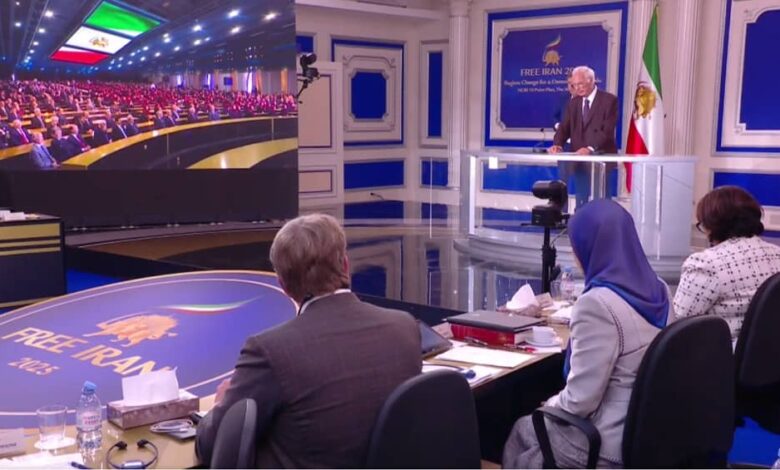
Former Dutch Senator Kees de Lange addresses an NCRI conference on May 31, 2025
Written by
Farid Mahoutchi
On May 31, at the second session of the 2025 Free Iran Conference near Paris, former Dutch Senator Kees de Lange delivered a resolute speech calling for decisive international action to end the theocratic regime in Iran. In his remarks, De Lange declared that the Iranian regime is crumbling under the weight of its own corruption, repression, and failure.
Describing the regime’s decline as “irreversible,” the former senator outlined three fronts of decay: economic, military, and above all, moral. He condemned Tehran’s ongoing support for terrorist proxies, its mismanagement of the economy, and its brutal crackdown on its own people. He stated bluntly: “When a regime considers its own people as its main enemy, how much more can it fail?”
Praising the Iranian people’s courage and the organized resistance led by Maryam Rajavi, De Lange said the NCRI’s Ten-Point Plan represents the only viable path toward a democratic Iran. He criticized the Dutch government’s ongoing policy of appeasement, comparing it to the fatal illusion of “feeding the crocodiles.”
He concluded with urgency: “Now is the time of regime change. Now is the time for increasing the international pressure on Iran. Now is the time for a future for the Iranian people.”
The full text of Kees de Lange’s speech follows. Portions have been lightly edited for clarity and flow.
Former Dutch Senator Kees de Lange: #Iran’s regime is now seen as a pariah state that must never gain nuclear weapons. The courage of the Iranian people, and the organized resistance under @Maryam_Rajavi’s leadership, sets a global example for freedom and democracy. pic.twitter.com/4D6wfrlQO1
— NCRI-FAC (@iran_policy) June 17, 2025
Friends of a free and democratic Iran,
The winds of change are blowing, and the criminal mullahs’ regime in Iran is crumbling. The irreversible decay is economic, military, and above all, moral.
The regime’s policies of funding criminal terrorist organizations in the region leave no room for economic development in Iran, resulting in widespread misery and hardship for the Iranian people.
Militarily, Iran and its proxies—such as Hamas, Hezbollah, and the Houthis—have suffered irreparable defeats that, despite frequent denials, are unmistakable.
Across the region, Iran is increasingly seen as the problem, not the solution.
But the most despicable aspect of the regime lies in its morals—seen for what they are by the vast majority of the Iranian population. When a regime considers its own people as its main enemy, how much more can it fail?
The regime’s grip on its population—those it is supposed to represent and protect—is at an all-time low. The Iranian people have risen in defiance. They no longer allow themselves to be intimidated. Those times are over.
Predictably, the regime’s response to its collapse—at home, in the region, and globally—has been increased repression.
Within Iran, suppression has reached intolerable levels.
In the region, the regime spews false rhetoric at every opportunity—convincing no one.
Globally, it has become a pariah—a pariah that must never be allowed access to nuclear weapons.
1. Senator Kees de Lange, former Dutch Senator, at the Second Free Iran 2025 Conference: “The winds of change are blowing and the criminal mullahs’ regime in Iran is crumbling.” #FreeIran2025 https://t.co/luhhbWGw82
— Iran News Update (@IranNewsUpdate1) May 31, 2025
It is important to analyze the reasons behind this clear decline of what is now a pariah state.
First and foremost: the courage of the Iranian people under brutal conditions is not only admirable—it is heroic.
Second: what principled and organized resistance can achieve under the leadership of Maryam Rajavi and the National Council of Resistance of Iran is an example to the world.
The NCRI’s international standing is now recognized by many governments and parliaments as the only road forward for Iran.
Madam Rajavi’s Ten-Point Plan is clear, visionary, and deeply rooted in democratic values.
Unfortunately, in my own country—the Netherlands—we are still suffering from the disastrous effects of appeasement politics toward Iran, clinging to the illusion that by feeding the crocodile, one will be devoured last.
But more and more nations, and their elected representatives, are waking up to reality.
And finally, the international context has shifted dramatically in recent months.
A major actor—the United States—has reversed its previous stance by 180 degrees. The regime is not pleased, and it will face increasing pressure as a result.
In conclusion:
Now is the time for regime change.
Now is the time for increasing international pressure on Iran.
Now is the time for a future—for the Iranian people.