
Iran’s Regime Faces Internal Reckoning as War Ends
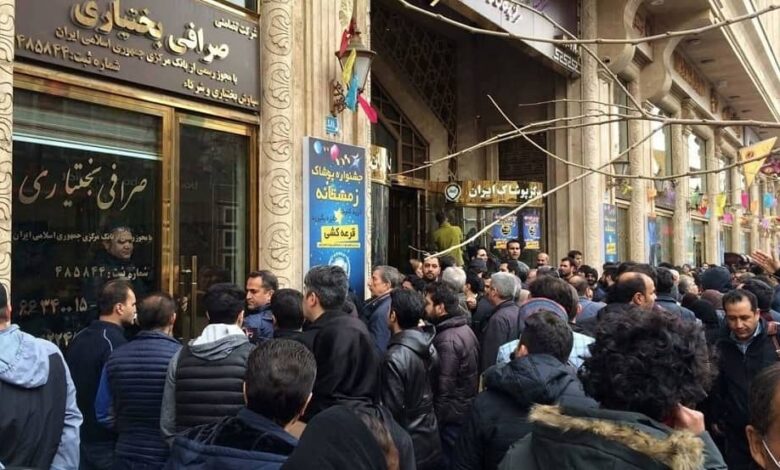
Crowds gather outside a currency exchange office in Tehran amid economic uncertainty and currency devaluation
Written by
Mansoureh Galestan
With the ceasefire now in place, the clerical dictatorship in Iran finds itself confronting a far more formidable challenge than any foreign adversary: its own people. The regime, battered militarily and economically, is entering a volatile phase where societal pressure—long simmering—now threatens to erupt.
The recent war with Israel and the United States, though brief, inflicted severe damage across Iran’s economy. Markets remain paralyzed. The rial has lost further value, cryptocurrency platforms were hit by security breaches and panic selling, and the Tehran stock exchange has yet to recover from its days-long shutdown. Basic goods have become more expensive and scarcer, particularly in provinces that saw internal displacement during the strikes. Despite official claims of “normal operations,” price shocks and drug shortages suggest otherwise.
Ali Madanizadeh, the regime’s newly appointed economy minister, steps into a collapsed landscape with virtually no functional policy tools. His long-term agenda—focused on foreign investment and “justice-oriented growth”—is strikingly misaligned with the current moment, where bread, medicine, and job security are the public’s urgent priorities. Crucially, real economic power lies elsewhere: in institutions beyond his control and in military-linked conglomerates that remain unaccountable even in crisis.
Shelters for Bombs, Not for People: #Iran's Regime Prioritizes Its Survival Over People’s Protectionhttps://t.co/lFsIqAj9Gi
— NCRI-FAC (@iran_policy) June 17, 2025
The Islamic Revolutionary Guard Corps (IRGC), often cast as the regime’s armored shield, did not escape unscathed either. The war degraded its missile systems and command structure. This weakening of the security elite not only exposed the limits of Iran’s deterrence, but has also created a rare power vacuum. With the enemy outside momentarily subdued, the focus within is shifting.
The regime now faces a restive and exhausted society that has endured war, isolation, and economic suffocation—none of which it consented to. The war’s propaganda victory is already beginning to lose volume. As daily life fails to improve, questions will multiply: Why was this confrontation initiated? What was gained? Who is to blame for the destruction?
Officials Fear Uprisings as the Economic Collapse Push #Iran on the Brinkhttps://t.co/sw8tYzKhuE
— NCRI-FAC (@iran_policy) June 9, 2025
These questions do not remain rhetorical in Iran. They carry political weight—potentially explosive weight. Civil anger, long redirected toward foreign threats, is turning inward. And this time, the regime’s traditional tools of deflection will not hold. Popular demands for transparency, accountability, and fundamental change will intensify, and even voices within the establishment will begin to question the wisdom of a strategy that led to such devastation with no lasting security or economic benefit.
As the dust settles, one truth grows clearer: the foreign threat is gone, but the real reckoning has only just begun.