
Regime Leaders and Media Call for Restraint as Iran’s Society Nears Breaking Point
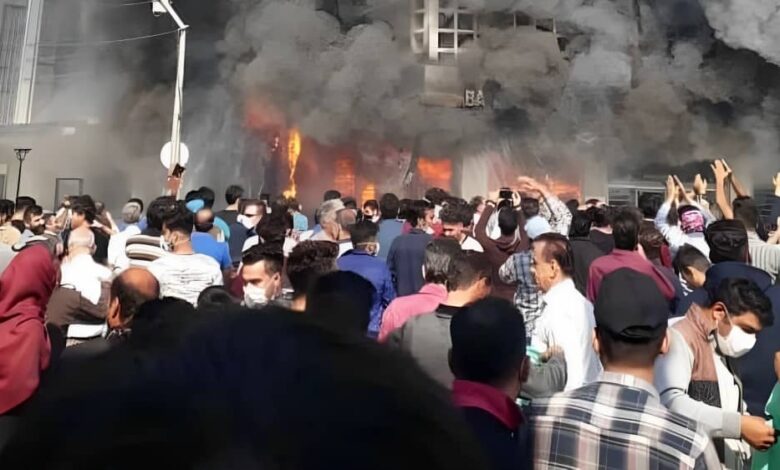
A widely recognized image from the November 2019 uprising showing a bank in flames near Tehran, Iran’s capital
Written by
Farid Mahoutchi
Amid a growing wave of national strikes and paralyzing unrest, top Iranian regime officials are now publicly urging authorities to “go among the people.” But this sudden shift in tone is not a pivot toward reform—it’s a last-ditch effort to defuse a society in open revolt.
On May 28, the regime’s Supreme Leader Ali Khamenei addressed provincial governors and Interior Ministry officials, declaring: “Go among the people. If they speak harshly, listen with patience… If this happens, they will help you in critical times.”
A day earlier, Judiciary Chief Gholamhossein Mohseni-Ejei echoed the same appeal during a national broadcast: “We must talk to the people. We must go among them. If we stay in our offices and rely on reports, we won’t grasp reality.” He added that officials must act quickly, so that people do not have to turn to “intermediaries or, God forbid, improper methods.”
#Iran News: Regime Insider Warns Officials’ Actions Risk Sparking Uprisinghttps://t.co/TXHrNEJGiA
— NCRI-FAC (@iran_policy) May 13, 2025
These synchronized calls are not coincidental—they are calculated. The regime, aware of its shrinking grip on power, is now turning to the illusion of outreach to calm a country that has already crossed the threshold of uprising.
In a revealing and unprecedented move, the state-aligned newspaper Ham-Mihan admitted on May 27 that the clerical dictatorship is facing a “comprehensive deadlock in governance.” In its article titled “Tighter Knots”, the paper described the situation in blunt terms: “There are no technical or isolated solutions to today’s problems. Conventional remedies only make the situation worse. The result is nothing but tighter knots.”
The article connects a series of urgent crises—nationwide protests by bakers, truckers, farmers, and workers; massive fuel smuggling; and halted industrial privatizations—to what it calls “a handful of interconnected factors” that expose the regime’s structural failures.
#Iranian Officials Voice Deep Fear Over Growing Social Tensions and Possibility of Uprisinghttps://t.co/NYjgVFrYGf
— NCRI-FAC (@iran_policy) April 20, 2025
Among the most damning admissions:
“There is a complete lack of trust between policymakers and the public. People do not take official promises seriously.”
“All decisions are made in secrecy. In an atmosphere of total distrust, all operations are non-transparent, and backroom deals flourish.”
“How is it possible that millions of liters of fuel are smuggled, palaces built with the profits, and no one knew for two decades?”
“The knife is at the throat of the treasury. But the state is unable to implement economic reforms—because no one trusts it.”
#Iran News: Shargh Daily Warns of Impending “Bread Uprising” Amidst Economic Collapsehttps://t.co/fxXKTuIfMC
— NCRI-FAC (@iran_policy) April 1, 2025
The paper warns that “even routine policy proposals are paralyzed by fear—fear of public backlash, or fear that no one will believe them.” As a case in point, it cites the abrupt cancellation of the SAIPA privatization plan: “Immediately canceled, not because of technical issues, but because trust is dead.”
And despite portraying these statements as analysis, the article’s implications are explosive. Ham-Mihan concedes that the entire regime is trapped by its own illegitimacy—a paralyzed system that can neither rule effectively nor reform credibly.
Khamenei’s metaphor of the “seven-headed dragon of corruption,” which he repeated again this week, is also unmasked in this context. For decades, he has insisted the “system is healthy,” even as embezzlement, fuel mafias, and state-linked rackets have gutted the economy. But as Ham-Mihan indirectly acknowledges, the rot comes from the head—and the people know it.
Khamenei's #EidAlFitr Speech Reveals Fear of Popular Uprising Over Foreign Threatshttps://t.co/dODyuhYMCU
— NCRI-FAC (@iran_policy) March 31, 2025
This sudden flood of “listening” campaigns and soft public messaging from the regime’s top officials is not a response to criticism. It is a containment strategy. The regime hopes it can simulate responsiveness and create just enough confusion to delay what it now fears is inevitable: a nationwide uprising fueled by economic collapse and political exhaustion.
As one analyst put it: “This is not reconciliation—it’s misdirection. the regime is hoping it can backpedal through a revolution already in motion.”
With summer approaching and protests multiplying across every major sector, the theocracy’s window to buy time is rapidly closing. And no parade of empty slogans will substitute for the justice and change that millions are demanding in the streets.