
Iranian Regime President’s Empty Rhetoric on U.S. Relations Sparks Domestic Backlash Ahead of UN Trip
Written by
Mehdi Oghbai
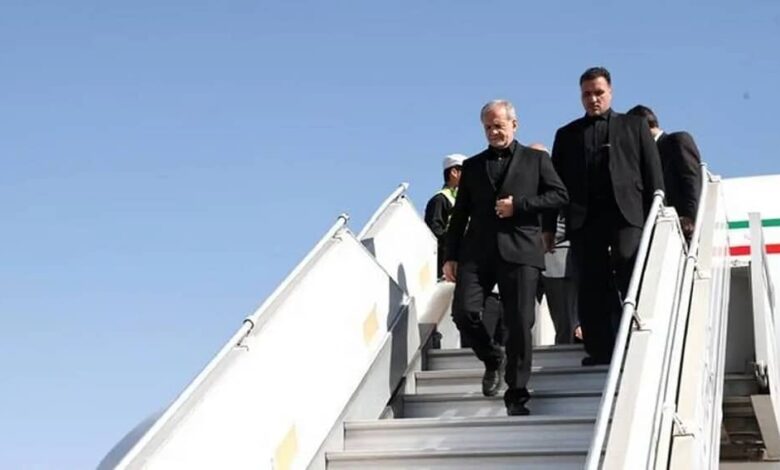
Ahead of his trip to the UN General Assembly in New York, the Iranian regime’s president Masoud Pezeshkian attempted to soften his stance on U.S. relations in a bid to deflect international criticism. However, his deceptive rhetoric has triggered a wave of domestic backlash, with leaders and hardline lawmakers condemning his comments as a betrayal of the clerical dictatorship’s core principles.
Mohammad Mahdi Hosseini Hamedani, the Friday Prayer Leader of Karaj, was one of the most vocal to publicly slam Pezeshkian’s remarks. “We cannot be brothers with America,” Hamedani declared during his Friday sermon, referencing the president’s comments. “We have both brotherly and paternal bloodshed with them because of the crimes they have committed against us and Islamic nations.”
He reminded the audience of the former Supreme Leader Ruhollah Khomeini’s warning, “As Imam [Khomeini] said, our relationship with America is like that of a wolf and sheep. We cannot trust them. Any notion of brotherhood with such a country goes against the principles of the Islamic Revolution.”
#Iran’s Internal Power Struggle Escalates Following #Pezeshkian’s Press Stunthttps://t.co/2djDuWUYxw
— NCRI-FAC (@iran_policy) September 18, 2024
Hardline MP Ali-Asghar Zarei launched a harsh attack on U.S. State Department spokesperson Matthew Miller while indirectly criticizing President Pezeshkian. Responding to Miller’s comments, Zarei wrote, “As a member of the National Security and Foreign Policy Commission, I say, ‘Shut up, killer!’ Don’t mistake the confusion of our president for your own achievement.”
At a press briefing on September 19, Miller had dismissed Pezeshkian’s suggestion of “brotherhood” with the U.S., stating, “And if he [Pezeshkian] wanted to show brotherhood with the United States or with other countries in the world, the way to show brotherhood would not be through rhetoric. It would be by stopping the arming and encouraging of terrorist groups, stopping nuclear escalations, and blocking the work of the International Atomic Energy Agency; it would be to stop plotting to kill political opponents, stop transferring missiles and drones to Russia, and ultimately stop cracking down on the human rights of its own people.”
Zarei also added, “The foreign ministry should have been summoned for the president’s carelessness on the eve of his New York trip, yet the parliamentary National Security Commission is asleep.”
Meanwhile, internal critics slammed the broader failures of Pezeshkian’s administration. Heshmatollah Falahatpisheh, former head of Iran’s National Security and Foreign Policy Committee, took aim at the president’s handling of economic issues. “Mr. Pezeshkian, the people are the victims of imbalance, not the cause of it,” he wrote. “Thirty percent of the value of our national currency is lost to those profiting from sanctions, while the rest is being looted by corrupt officials.”
Power Struggle Intensifies in #Iran as Rival Factions Slam #Pezeshkian’s Governmenthttps://t.co/j6FF8DT5LL
— NCRI-FAC (@iran_policy) September 12, 2024
The growing dissatisfaction with Pezeshkian’s leadership was also reflected in state-run media. A column in the state-run Shargh criticized the regime president’s failure to implement reforms: “The pace of decision-making in the administration is slow, and even the president himself seems hesitant to make changes. If discredited figures remain in key positions under the guise of national unity, what was the point of change in the first place?”
The state-run newspaper Ham-Mihan wrote, “Can you imagine a country where, while the president is holding a press conference, the media—funded by the government—runs a blatantly negative poll against the president and his cabinet?”
Supreme Leader Ali Khamenei, in a speech on September 21, once again called for unity among Muslim nations, not for peace or cooperation, but to further Tehran’s ambitions for regional dominance. “We are currently lacking an Islamic Ummah [a unified Muslim community]… we are divided,” he complained, underscoring his frustration with Muslim countries that resist falling in line with the regime’s agenda.
While his rhetoric was directed at Arab nations, his domestic audience knew exactly where his priorities lay. Khamenei’s calls for unity were thinly veiled attempts to rally support for Tehran’s confrontational policies, including its backing of proxy wars and destabilization efforts across the region. As he lamented that “the power of the Islamic world comes from unity,” it was clear his real objective was to consolidate power and assert his hegemony, all while ignoring the deepening internal strife and economic crises plaguing his own regime.